

PugJesus
History Major. Cripple. Vaguely Left-Wing. In pain and constantly irritable.
- 4.18K Posts
- 5.47K Comments
Joined 1 year ago
Cake day: March 24th, 2025
You are not logged in. If you use a Fediverse account that is able to follow users, you can follow this user.
 4·3 hours ago
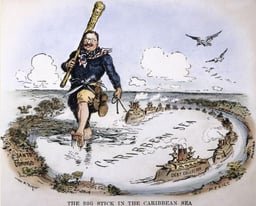
Explanation: The Treaty of Sevres was the treaty imposed upon the defeated Ottoman Empire after WW1. While the creation of theoretically-independent ‘mandates’ of much of the Ottoman Empire’s foreign holdings was probably inevitable, the proposed butchery of the heartlands of Anatolia, where the Turkish population of the Empire actually lived, was ridiculous and far beyond what the victors of WW1 had imposed even upon Imperial Germany and Austro-Hungary - both objectively far more at fault for the war than the Ottoman Empire. But such affairs are conducted according to the (im)balance of power, not justice.

That considerable territory was to be ceded to the Greeks, whom held long-lasting enmity with the Turks, was additional salt on the wound. The Ottoman Sultan felt that, as a defeated power, he had no choice but to sign it if he wished to keep his throne.
However, the wellspring of outrage was so total that a hero of WW1, one Mustafa Kemal Pasha (later known as Ataturk) managed to rally the people and remaining military forces of Turkiye to oppose the treaty, leading to the expulsion of occupying forces and the overthrow of the Ottoman Empire in the Turkish War of Independence. The resulting Turkish Republic would renegotiate the peace with the victors of WW1 after several years of fighting, leading to the roughly modern (and unoccupied) borders of Turkiye we see today.
 13·3 hours ago
Explanation: The Treaty of Sevres was the treaty imposed upon the defeated Ottoman Empire after WW1. While the creation of theoretically-independent ‘mandates’ of much of the Ottoman Empire’s foreign holdings was probably inevitable, the proposed butchery of the heartlands of Anatolia, where the Turkish population of the Empire actually lived, was ridiculous and far beyond what the victors of WW1 had imposed even upon Imperial Germany and Austro-Hungary - both objectively far more at fault for the war than the Ottoman Empire. But such affairs are conducted according to the (im)balance of power, not justice.
That considerable territory was to be ceded to the Greeks, whom held long-lasting enmity with the Turks, was additional salt on the wound. The Ottoman Sultan felt that, as a defeated power, he had no choice but to sign it if he wished to keep his throne.
However, the wellspring of outrage was so total that a hero of WW1, one Mustafa Kemal Pasha (later known as Ataturk) managed to rally the people and remaining military forces of Turkiye to oppose the treaty, leading to the expulsion of occupying forces and the overthrow of the Ottoman Empire in the Turkish War of Independence. The resulting Turkish Republic would renegotiate the peace with the victors of WW1 after several years of fighting, leading to the roughly modern (and unoccupied) borders of Turkiye we see today.
Explanation From Wiki:
https://en.wikipedia.org/wiki/War_of_the_Golden_Stool
The Golden Stool had long symbolized governing power for the Ashanti people.
On 19 March 1901 British statesman David Lloyd George stated in a Parliamentary session that: “Frederick Hodgson’s quest of the Golden Stool was something like the quest of the Holy Grail”. The Member of Parliament of Caernarfon as well as other members of the House were extremely concerned about the huge expense that the House was being made to pay for the war. Joseph Chamberlain, then Secretary for the Colonial Office, was questioned extensively as to whether or not Frederick Hodgson had actually been given prior permission to demand the Golden Stool from the Asante people, because he seemed to think that “if he could only get possession of the Golden Stool he would be able to govern the country for all time”.[13]
Hodgson advanced toward Kumasi with a small force of British soldiers and local levies, arriving on 25 March 1900. Hodgson, as representative of a powerful nation, was accorded traditional honors upon entering the city with children singing “God Save the Queen” to Lady Hodgson.[14] After ascending a platform, he made a speech to the assembled Ashanti leaders. The speech, or the closest surviving account that comes through an Ashanti translator, reportedly read:[15][better source needed]
Your King Prempeh I is in exile and will not return to Ashanti. His power and authority will be taken over by the Representative of the Queen of Britain. The terms of the 1874 Peace Treaty of Fomena, which required you to pay for the cost of the 1874 war, have not been forgotten. You have to pay with interest the sum of £160,000 a year. Then there is the matter of the Golden Stool of Ashanti. The Queen is entitled to the stool; she must receive it.
Where is the Golden Stool? I am the representative of the Paramount Power. Why have you relegated me to this ordinary chair? Why did you not take the opportunity of my coming to Kumasi to bring the Golden Stool for me to sit upon? However, you may be quite sure that though the Government has not received the Golden Stool at his hands it will rule over you with the same impartiality and fairness as if you had produced it.
Explanation: In WW2, the decision-makers of Nazi Germany increasingly prioritized ‘impressive’ and increasingly heavy tanks over the more mobile designs of the Interwar period and early WW2.

Surely THIS ridiculous wunderwaffe will bring the Thousand-Year Reich victory! Do you not believe in the endsieg, TRAITOR?!
Explanation: Marcus Aurelius was a Roman Emperor who is noted for his philosophical musings, recorded in his personal notes, which were posthumously published as his Meditations. The title is a quote from the Meditations, emblematic of the philosophy of Stoicism that Aurelius espoused. To the Stoics, suffering came from within - by tormenting oneself over things one could not change, past, present, or future, one inflicted unhappiness upon oneself. The path to happiness, then, was to do what one could, and refuse to worry about what matters one could not change.
Stoicism and Cynicism were both related Greek philosophies of the period which stemmed from the same roots. While both philosophies held appeal to the Romans, Stoicism, which espoused reason and duty as the path to ataraxia (the state of non-suffering) and harmony, was generally more accepted in Roman culture than Cynicism. While Cynicism’s “Go with your gut, overthinking will lead you astray” thinking was also appealing to the Romans, the broader rejection of social norms was generally disdained by Roman culture. What’s next, acting like BARBARIANS!?
Cynicism, for that matter, comes from the Greek word for ‘dog’, after Diogenes of Sinope, a homeless philosopher who hung out with stray dogs and often compared himself to them, and influenced both Cynicism and Stoicism in seeking a natural, minimalistic order to life and happiness.
Both philosophies which espoused a view of the world as having an intrinsic harmony that could be discovered and adhered to for human happiness; thus, animals, while ‘brutish’, were often seen as themselves acting in accordance with this intrinsic harmony. A dog doesn’t worry about philosophical matters, after all!

Not my work! I’m but a humble reposter!
 2·8 hours ago
Colloquially ‘Austria’ (or equivalents) was still widely used, just as the Ottoman Empire is referred to Turkiye here.
 20·8 hours ago
That shot is aesthetic as fuck
Reddit
The original OP probably used a different source, and the exact duration may have been linked to a particular estimate. But the 750s to 790s confirms that general timeline.
“Oh man, I just shot Mustafa Kemal in the face”
Context From Original OP:
The Anxi army of the Tang Dynasty held out in the desert for 42 YEARS without reinforcements
Context From Wiki:
https://en.wikipedia.org/wiki/Protectorate_General_to_Pacify_the_West
After the An Lushan Rebellion (755–763) was suppressed, the office of Protector General was given to Guo Xin, who defended the area and the four garrisons even after communication had been cut off from Chang’an by the Tibetan Empire. The last five years of the protectorate are regarded as an uncertain period in its history, but most sources agree that the last vestiges of the protectorate and its garrisons were defeated by Tibetan forces by 790, ending nearly 150 years of Tang influence in Central Asia.
 4·21 hours ago
He could be you! He could be me! He could even be-!
If this was taken in, say, 1890, it would have only been 14 years since the samurai were formally abolished, and numerous young men would have been training for most of their adolescence in that tradition. These fellows could easily be in their 30s - even old enough to have been in the role of a samurai in their 20s.
It could also just be folks posing, like you suggest, but the possibility that they are genuinely samurai, or ex-samurai, is not particularly unlikely.
The samurai class wasn’t formally abolished until 1876, and many of the men who had grown and trained as members of that aristocracy would have still been alive even at the turn of the century.
Every Pomeranian I’ve ever met has been an insufferable spoiled little shit, but they are adorable
You might be surprised! Roman government was less directly democratic than Athens, but the franchise was much broader. Only about 10% of Athenians were citizens - by contrast, nearly two-thirds of the Late Republic’s population in Italy is estimated to have been citizens. The concept of popular sovereignty was extremely core to Roman ideology, and even legalistic violations of that principle could incur incredible unrest, even going into the Empire.
Not only that, but while casual histories often discuss the Senate as though it was the main organ of governance, the fact is that, counterintuitively, the Senate served a more executive than legislative role - all new laws had to be voted on by the Popular Assemblies, and the main route to enter the Senate to begin with was to be elected as a magistrate - again, by the Popular Assemblies.
Certainly, though, the Senate that Octavian was making pleas to had little love for democracy - it was precisely democracy that the oligarchs which dominated the Senate had spent the past ~100 years opposing, to the ruin of the Republic.
Explanation From Original OP:
According to legend, approximately in 1600 clergy wanted to ban coffee because it was a Muslim drink. Pope tried it and instead of banning blessed it.
Let’s not start any fights in here, certainly not over semantics. XD
Moderates



I don’t know that the proper response to “Ethnic cleansing against Armenians by the Turks” is “Ethnic cleansing against the Turks by the Greeks”, tbf.