
From Center for Wildlife
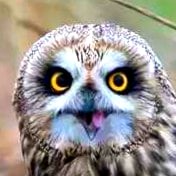
This great horned owlet was admitted this week after being found on the ground in the rain. She is about 3 weeks old, we can tell that she is a nestling by her weight, stage of feather development and behavior. The best thing for a wild animal is to be raised in the wild by their parents, and as such we scout the areas where nestlings are found to exhaust the option of returning them to their nest and parents. Unfortunately, we have not found the parents, and this little one has slight bruising and dehydration.
She will be raised at the center, and once strong and old enough to leave the nest, we will again attempt a reunion. In the meantime, beyond proper nutrition, husbandry, medical treatment and supportive care, it is critical that we do not interact with raptors like these. If they become “imprinted” on humans, it essentially ruins their chances at a wild life for good. When we go to feed, clean, or handle for medical care, our team will wear this mask that mimics the face of an adult great horned owl.
We will also try to get this baby in with another of her species, whether another orphan or adult patient as soon as possible. Prior to this Highly Pathogenic Avian Influenza outbreak, our ambassadors animals like Gaia and Galileo (our male and female non-releasable great horned owl pair) served as foster parents for any orphaned wildlife of their species. Unfortunately this outbreak has made that process risky.
Stay tuned for updates on this already fierce (the way we like them!) owlet!
Did you know? Wildlife rehabilitation is not government funded, and is the lowest priority (1%) of charitable causes people donate to. We are here only thanks to donations from individuals, local businesses and family foundations.


What a big and fluffy baby!
They are so awesome! We’ve currently got 3, and I think maybe a 4th still being evaluated.

I’ve fed both these hoodlums twice now. The first time, the one in front tried to bite me, little trouble maker!

This one is by himself (I don’t think he’s as close to being flighted as the other 2) and one a different feeding schedule, so he wasn’t fed on my shift.
He looks pretty close to being grown, except for how fluffy he is.
They’ve all still got lots of feathers to grow and muscles to develop. They grow fast though, and will be doing their branching stage at about 6 weeks old, and then they start flying around 10-12 weeks. Not bad for a 3 month old!

