

From Wildlife in Need PA
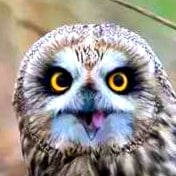
🦉A Fierce Great Horned Owl ❤️
This Great Horned Owl (GHO) found herself in quite a predicament when she managed to get into a chicken coop and couldn’t find her way back out. The finder reached out to her friend Leigh, one of our Capture & Transport permitted volunteers, for help. During the rescue, it became clear that the owl had a serious eye injury.
According to Leigh, she was the most fierce Great Horned Owl she had ever captured! That feisty spirit would certainly come in handy on the road ahead.
The owl was transported to Dawn, a licensed vet tech and sub-permittee of Tamarack Wildlife Center (TWC), for immediate care. Her journey then included a trip to Humane Animal Rescue of Pittsburgh (HAR) for surgical removal of the injured eye, followed by a return trip to Dawn to continue her recovery. After completing her antibiotics and passing her flight exam, she was finally ready to go home!
Leigh and Dawn shared the honor of releasing her fairly close to where she was found, giving her the opportunity to return to familiar territory… And true to form, this fierce girl wasn’t about to cooperate with any photo or video plans! 😂 She quickly flew towards the treetops and disappeared from sight.
A huge thank you to Leigh, Dawn, TWC, and HAR for helping this determined owl get her second chance at freedom!
Dumb questions but is she going to survive in the wild with just one eye? (Dumb because I strongly assume you’re all experts with better judgement than me). Or better asked: Don’t owls need both eyes to locate and catch prey with binocluar vision?
Not a dumb question at all!
For most animals, you would be correct that this would not bode well for them. Many owls have a trick up their sleeves though: asymmetrical ears.
Most, but not all owls have a higher left ear. This lets them find prey on moonless nights, or under snow/leaves. The slight delay in sound between one ear and the other lets them triangulate what they are listening to. It is a bit like Daredevil’s super hearing, so they can somewhat get a 3D image of sound. This can make up for the lack of visual depth, as it’s already a built-in tool they have and are used to using.
They test the owl’s abilities to locate food before release of course, but many can adapt without issue.
More than you ever wanted to know about owl hearing
Let me know if you have further questions!
Thanks for the detailed answer!
I knew about owls’ three-dimensional hearing, but I didn’t expect that they could even use it to compensate for their sense of sight. I thought they needed both for hunting. As I’m now learning, fortunately for this eagle owl, that’s not the case.
Thanks again for the answer and keep up the good work! ^^
Roger Payne did the first study showing owls can hunt perfectly well with no eyesight.
He was also very famous for all his work studying whale communication. His first wife also studied whale and elephant communication, so when it comes to animal sounds, they were kind of what the Curries were to chemistry.