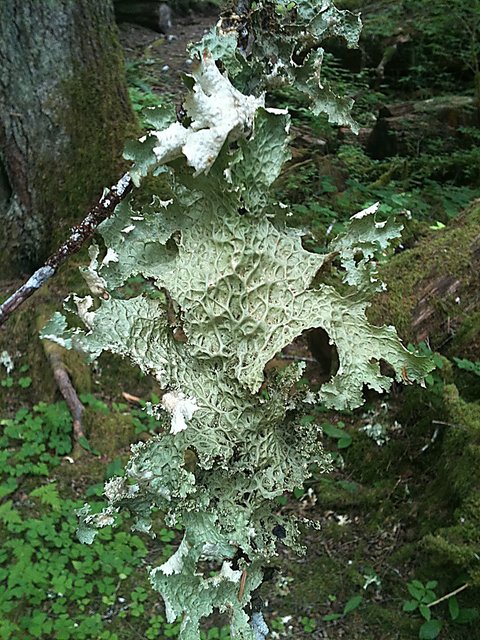
like, lichen are these things:


they grow on any solid surface, rocks, trees, everywhere. they do not typically feed on the object that they grow on, or at least it is not their primary source of energy. rather, they embed photosynthetically active organisms within themselves. so, here’s a schematic:

what’s labeled as (b) here is the “algae layer”, these are cyanobacteria (black dots) embedded into the fungus structure of the whole organism (layers a - e). so it’s a fungus, overall, with extra cyanobacteria embedded into it. these are technically separate living beings, with their own set of DNA. they just live together. symbiosis on a rather closely-linked level. in most cases, the cells touch, but stay separate cells. in some cases, the fungus cells basically infiltrate the cyanobacteria for closer contact and faster transport of nutrients. the advantage of the fungus to the cyanobacteria is that it protects the cyanobacteria against stresses from the environment, like dessication and excessive radiation. in exchange, the cyanobacteria produces sugar.
so what i find fascinating is to compare this to the endosymbiotic relationship of cyanobacteria and plant cells. just like the fungus provides protective structure, so does the plant (eukaryotic organism) cell. it’s a big cell that provides housing so the endosymbiotic chloroplast is protected from the environment.


–>

You must log in or # to comment.
I tell my mam to start a youtube channel called: “Lichen subscribe” whenever she starts going on about them.
I always think of lots of complex lifeforms as fancy meatbags protecting and feeding complex colonies of bacteria , even virus type things inside them largely symbiotically. Like in futurama ‘Parasites lost’.
But this is turning into more of an enema thought than a shower .
Yeah but not like that. More like, “these are plants, right? No? They’re a mold? Okay. But they look like plants.”
deleted by creator
Not all moulds destroy what they grow on. You’re thinking of spoilage moulds, but there are others
You take long showers.
physics is all about boiling water!

Why’s there a flag of north korea in the background?
He was in North Korea in the movie (The interview)
You clearly are not familiar with lettuce lichen.