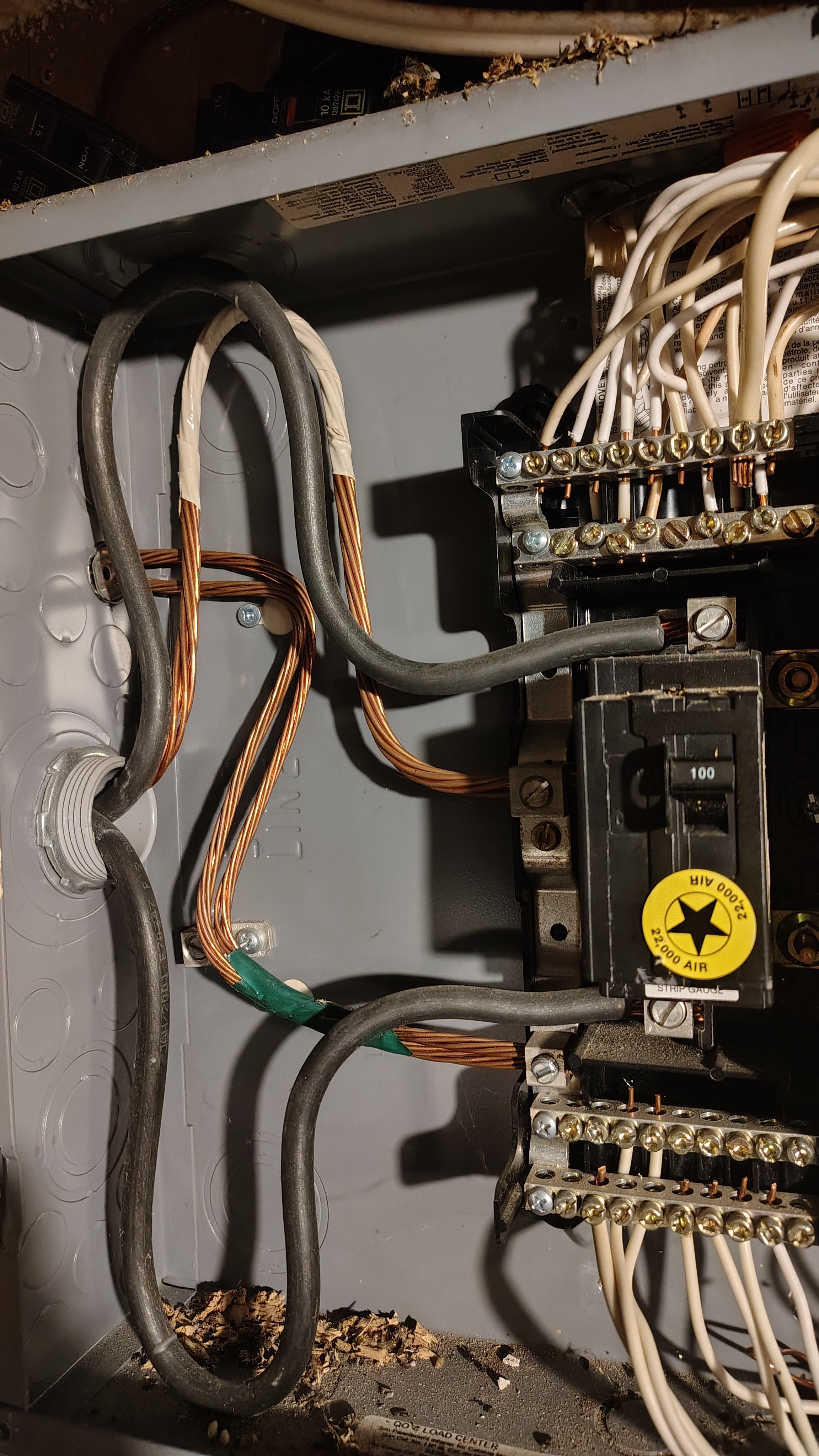
The white ground is going out to the pole and the green one is my grounding rod, should the green one not be bonded to the pannel not the bus bar?
Note not an electrician, but my copper water lines feel live and a few switches in my house give us shocks
You must log in or # to comment.
If you’re asking questions like this, you should probably hire an electrician. You can hurt yourself or others in your house if you mess up your grounding.
I don’t know your exact panel but it looks like you’ve mixed up neutral and ground.
If you’re getting shocks from anything, best call an electrician now.
I say this as someone not licensed, but I understand household electrical very well - call an electrician.
When I bought my house, I found that if I touched the stove and anything else that was grounded at the same time, I would get shocked. That didn’t happen anywhere else in the house. After doing some investigation, I realized that the former owner, being an engineer, decided to wire the house himself, and was very creative with how he decided to wire things, doing things such as disconnecting the fucking neutral from the stove, because even though the wire was there, he didn’t connect it.
Fortunately, fixing simple grounds at the plugs and at the appliances is something that is within my wheelhouse, so I spent a few weekends here and there, re-connecting all of the grounds and wiring things correctly, and since then I have had no problems.
I said all of that to say that if it is one specific thing that is shocking you, then address that one simple thing. But if it is all throughout the house, hire a goddamn electrician.
It’s gonna suck to shell out $600, $800, $1,000, whatever it costs to get that fixed. But paying that money sucks a whole lot less than being electrocuted.
Wow. Just, wow.
Well, glad you figured it out to be here today.
I’ve seen similar with an electric stove, someone had attached the cord incorrectly, so occasionally you’d get a shock touching it. It’s been a long time, I guess they flipped neutral and ground.
In the service panel, aka the main panel, it is OK for ground(bare copper with green tape) and neutral(white leg) to be bonded together.[1]
For sub-panels, it is not.
In any event, if you are not knowledgeable enough to inspect and diagnose potential electrical issues please call in a professional!
[1] https://www.whittinspections.com/home-inspections/subpanel-bonding-subpanel-wiring/
I have never seen a bare neutral wire though? Ground is bare, is that normal? Usually it has the insulation.
Neutral is usually bare all the way in from the utility poll and stays that way down the riser. Ground is usually bare as well. At least as far as the main panel. Once you start routing to sub-panels this can change to be sheathed and color-coded like you expect.
Others have mentioned the possibility of interruptions to the ground somewhere outside the panel and I would definitely consider that. I also don’t love how close the ground and neutral leads look in the upper left-hand corner of the photo. They should not be in contact until they meet on the top of the bus.
It sounds like you’ve got a grounding problem that may not be inside the panel. Is there an actual grounding rod?
I’ve seen people hook the ground to copper pipes, but that’s not up to code and can energize the plumbing.
I’ve also seen grounding rods cut in half to make them easier to drive (and get to snatch the extra copper).
Not if this is the first disconnecting means after your meter. The green screw is bonding the bus bar to the panel and makes the neutral have a potential equal to that of the ground, so it is a ‘return’ path for the split phases to get 120V rather than the full 240V single phase that’s coming from the utility. If this isn’t the first panel after your meter you would isolate the neutrals from the ground/panel so you don’t create parallel paths for the electricity to flow during a lightning surge. https://imgur.com/a/zVSkSug
Let me also say that messing with your own house wiring the danger is not electrocuting yourself. There’s just not enough voltage to likely do that. The danger is making an improper connection that causes a fire and that’s why you should get a professional if you’re unsure and don’t understand the risks involved.
I must disagree with the not elextrocuting yourself".
120v with 50a+ service (200 is common these days) is plenty to kill you, especially a novice.
What need is there for a 200 amp circuit? We had to install 50a to power a 40ft camper and it’s in a separate box.
The 200 amps would be the entire service from the utility meter for a single family home. It’s definitely overkill on most houses but with the electrification of everything it’s probably for future proofing. Big houses or properties with multiple detached structures will occasionally have a 400 amp service but the utility meters they put on those are only rated for 320 amps continuous so I think 400 is also overkill for those types of properties usually.
Yeah. I have 200 amp service but it’s because I have a car charger, heat pump, electric furnace, induction range, electric water heater, and a server rack. That being said, I’ve never even come close to using all 200 amps at once. It’s at least good piece of mind in case that randomly happens for some reason, though.
Of course it’s plenty under the right conditions but it’s very easy to use insulated tools or gloves and not be at any risk of shock. Or you can work with the power shut off at the transformer or get the meter pulled. On the other hand you might not know you’ve created a situation that will burn down your house until way later and it’s too late. I’ve touched a 120v leg on a 200a bus by accident and barely felt a tingle in that situation. The expertise is not in trying to not be shocked because that’s the obvious risk. The less obvious risk is dying in a house fire because of an arcing connection somewhere that doesn’t cause a breaker or fuse to trip.
I think this is it, I would gather that those two smaller open copper connections are heading off to subpanels. I would suggest if you really have to know get an ok multimeter and test the ground to each of the prongs (inlets) separately, then if anything is on the neutral to ground that is a massive issue, or if there isnt 110V(+/-10%) from live to ground or not the same from live to both, that is a harder issue. But that as a home owner (who wants to be informed) is as far as I would suggest. (if you feel comfortable with a multi meter, but also be aware you should have your hot leg on your smaller prong entrance, but if shits fucked [even if not] you NEVER trust this thing is wired correctly)