
Aged 32, finding each year more enjoyable as I grow into a career and have more disposable income
I am more content with who i am now but I am also quite restless and I’m finding it difficult to connect to people
Not necessarily, but for the last couple decades the world has been getting progressively shittier, so it might feel that way, especially when you have chronic depression due to the world getting progressively shittier.
(Also the people you care about get older and sicker, and will eventually die, and you can’t really do much about that, which isn’t particularly fun either. It all builds up into the chronic depression.)
I think there may be something to brain chemistry and physical make-up changing over time, but I’d argue that for most people happiness is environmental.
I Norway there was a watershed moment in this question a couple of years ago.
Young adults (students) had always reported being more happy than older people (retired), on average.
Then, abt five years ago, this flipped! The older, retired people reported being more happy than young adults.
I’ll see if I can find the link
im 30, id have to say no, at least to this point
Sort of. Your brain produces less dopamine because it’s focused on retaining knowledge rather than enforcing learning.
In general, yes.
From my anecdotal perspective, it seems to me like lots of people around me stopped prioritizing their own interests and needs in their late 20s.
I did not.
I enjoy the life I’ve built.
They, apparently, do not.
YMMV
Depends on what you do with your time. I’ve found that as long as you keep learning, you’re fine.
Happiness is an U curve according to some research.
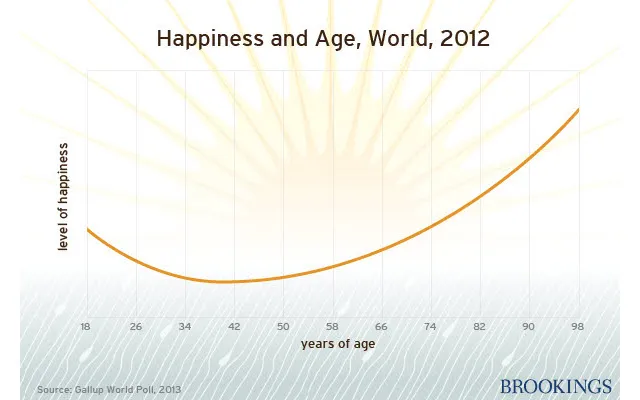
As death approaches, happiness increases.
It’s true, suicidal people have a strange phenomenon where they seem happy for a short time, because they know they don’t have to worry about their lives anymore, just before they take them
That was 13 years ago, I’m also curious how much that relates to world events vs age
Mostly, yes. The following is obviously a generalization.
Children are in a state of growth, so they heal quickly, in a state of care, so their needs/wants are usually met without effort, and in a state of ignorance, so they often aren’t aware of all the awful things they are surrounded by.
Adolescents are still in a state of growth, but it’s unstable, meaning they can feel awkward. They are in a state of semi-care, so many of their needs are cared for, but not all, and certainly not all of their wants. And they are often coming to realise the horrors of the world which were hidden before. They see and begin to comprehend death, tragedy, human cruelty and frailty, etc. though the concepts are usually distant.
Adults are worse off still. They get hurt and it’s permanent because the only growth they get to experience is cancer. They are expected to care for themselves almost completely, with little support entitlement. And they become not only aware of death and tragedy but correctly expectant that it will come for them. And they often then have kids, which means they have to provide the child’s full care on top of, and even in place of, their own. If they didn’t fall in love with the kids, they’d probably commit some combination of murder and/or suicide to escape them.
The elderly round things off. They are in near constant pain from all the damage done to their bodies. They are still expected to mostly care for themselves, or have saved up enough money/obligation to carry them through to the end as their bodies crumble. They are very aware of their impending doom as they watch friends, family, and personal heroes die around them. If they are wise, they are painfully aware of the foolish mistakes of those around them and have to watch their loved ones walk into the same holes into which they walked and from which they climbed years ago, and have all the experience to understand a world that has changed by the time they understand it. If they have children, they teeter between having to care for them and needing to be cared for by them. If not, they are forced to be still selfreliant as their ability to be so disintegrates.
And then there are the dying. It’s usually a painful process. That’s gotta suck.
Until the current generation, happiness was generally a u-shaped curve, with happiness going down around their early 20’s and coming back up around the 60’s.
Gen Alpha doesn’t seem to have a happy childhood.
Gen Alpha doesn’t seem to have a happy childhood.
In some regions, yes. But not everywhere. They mostly seem happy to me
For parts of the world with data going back to boomers and earlier, there is a quantitative slide.
This study https://www.spring.org.uk/2024/12/age-most-depressed.php shows people getting more miserable towards middle age, then getting happier. The happiness graph makes a smile shape of course.
I wonder how the happiness in old age is seperated by wealth. like those on public assitance in homes compared to those with enough wealth to stay in their homes till death.
I thought I saw something about income increasing happiness but only up to a certain level (and then saw more studies that disagreed), i always thought it’s probably more correlated in Western countries where status and income are almost synonymous.
We present evidence that psychological well-being is U-shaped through life. A difficulty with research on this issue is that there are likely to be omitted cohort effects (earlier generations may have been born in, say, particularly good or bad times). First, using data on 500,000 randomly sampled Americans and West Europeans, the paper designs a test that can control for cohort effects. Holding other factors constant, we show that a typical individual’s happiness reaches its minimum - on both sides of the Atlantic and for both males and females - in middle age. Second, evidence is provided for the existence of a similar U-shape through the life-course in East European, Latin American and Asian nations. Third, a U-shape in age is found in separate well-being regression equations in 72 developed and developing nations. Fourth, using measures that are closer to psychiatric scores, we document a comparable well-being curve across the life cycle in 2 other data sets (1) in GHQ-N6 mental health levels among a sample of 16,000 Europeans, and (2) in reported depression-and-anxiety levels among 1 million UK citizens. Fifth, we discuss some apparent exceptions, particularly in developing nations, to the U-shape. Sixth, we note that American male birth-cohorts seem to have become progressively less content with their lives. Our results are based on regression equations in which other influences, such as demographic variables and income, are held constant.
I dont’ think its status as much as a decent basic necessitites thing along with security. If you have the money to live in a decent, clean, healthy environment with food and knowing health needs or such will be met and then further know that will be the case until you die. Then its much easier to be happy. I get the studies though but im always suspect. Like how much of the U is specific to a sorta point in time and is it eroding for people getting to those ages.
I did not have a very happy childhood but it improved in high school and college. Late college and working world sucked but got a job in a nice place and it went up but it paid low so had this anxiety about the long term. then it became a slog and now everything has collapsed. So for me personally. Kinda? There was this idea of work hard and sacrifice to get ahead but it did not really pan out and I kinda wonder if taking drugs and living for the day might have been the better way to go.
I don’t know about others, but as I grow older and realise I have progressively less time left, I grow less patient of other people’s bullshit. Some people may consider it a symptom of diminished happiness, but it’s more a degradation of my social filters.