You must log in or # to comment.
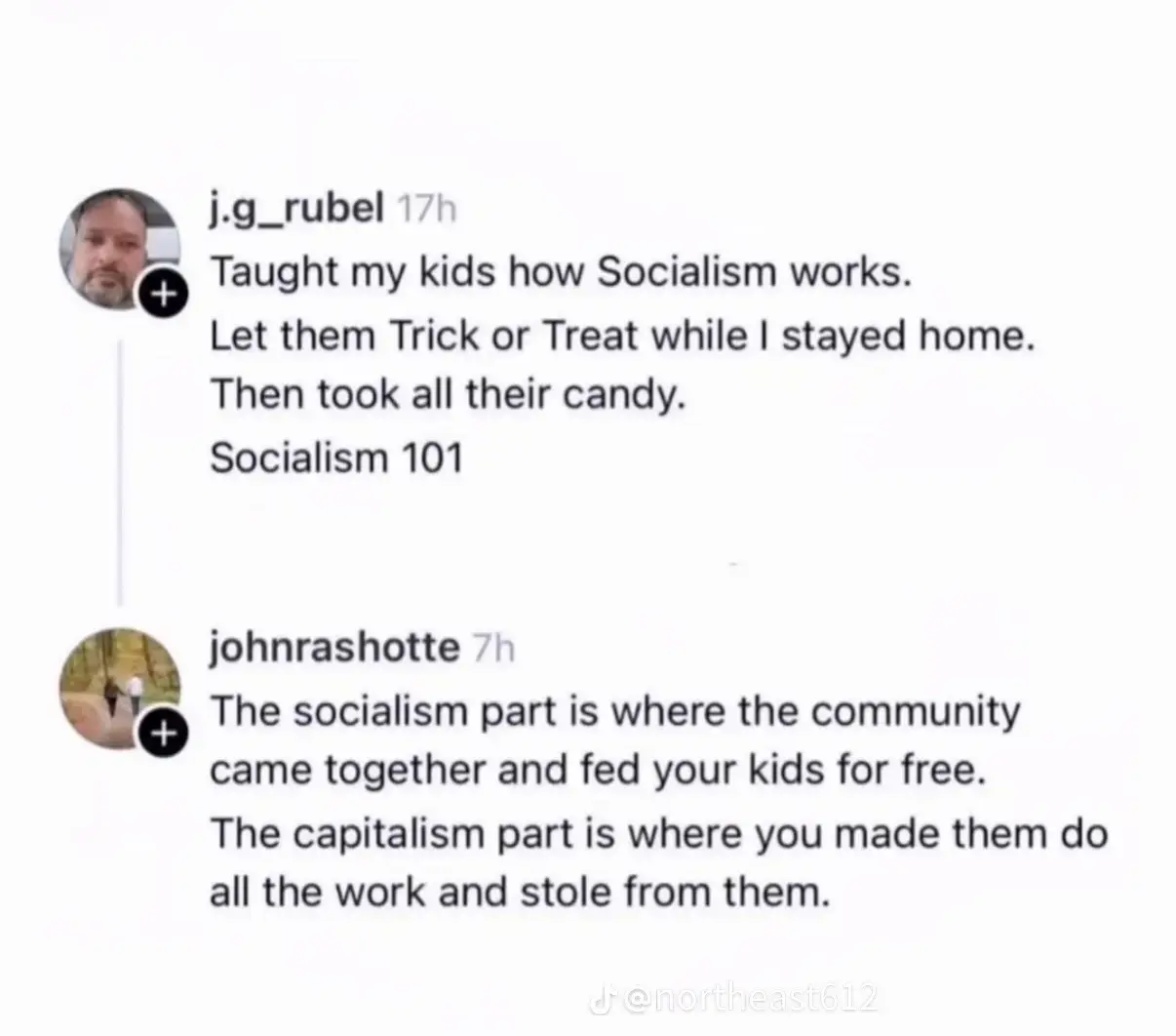
There’s sharing resources and then there’s being a dick.
In any case talking in this way to kids is basically indoctrination as they don’t have the resources to fully understand.
A dad should teach them universal values such as understanding and compassion and when they’ll be adult they can choose for their own. The problem for these people is that if you teach compassion to your children it’s unlikely they’ll turn out to be Maga as their parent.
another problemcis - to teach something, you should know / understand it first.
Shitty people raise shitty people.
That’s where the introspection and emotional work (and therapy) we should all be doing as adults comes in. To unlearn the (childhood/generational) traumas that we picked up from our parents, friends, and society and try to become better people.
But that shit is hard and uncomfortable to actually do, thought terminating cliches and bigotry are easy, so here we are.
It’s awesome how stupid people who have no education can spread their thoughts. /s
What sucks is that they are really good at spreading it because they speak very confidently.
Is this a stupid person spreading his thoughts or is this a smart person spreading capitalist propaganda?
And their genes, don’t forget that this guy successfully manipulated his contribution to the generation into believing socialism is when capitalism. Likely on their way to being a part of MAGA.
How the fuck is eugenics propaganda still this prevalent?
This guy’s speech comes out of a premise so moronic that any answers trying to correct it will only lead to a moronic conversation.
I mean, the guy thinks socialism is about stealing candy… What kind of conversation can you infer from that?
That you took the example literally?
Ignorance is loud, what’s new
Ah yes, the famous socialist concept of ultra rich CEOs and shareholders. Damn you, Karl! We could have lived in a capitalist utopia if you didn’t invent that cancer.
j.g_rubel = Russian Troll Farm account 22728728273 on X.
I cannot wait to watch Musk wear a blindfold while his sentence is read VERY LOUD to him. It WILL happen.
I’m sure people said the same about the robber barons a century ago. Sadly they all died of old age surrounded by luxury. I’d like to think justice has caught up a bit, but… well, ruthless rich fucks have been dying of old age in luxury for a long time.
this one is easy to look up, too… the last time rich fucks got culled en masse was like…the french revolution?
and arguably that kind of event does set a country back. it just acts as a unifying “other” for the rich fucks, most of whom content themselves living a life of hedonism, occasional self-fellating/inefficient act of volunteerism (helps forget where their $ comes from), and maybe occasionally fucking over someone in some petty social grudge.
random acts of violence mostly just create more problems, build resentment etc…targeted acts of violence is what solves problems
unrelated, but the proper capitalists happen to be a much smaller, purposefully isolating group.
man, these oversimplifications got out of hand.
Removed by mod
Communism definitionally does not have a government.
I prefer to imagine the people and the government are one in the same. It’s an easier leap
And yet…
Yeah, and yet westerners blasted with anti-communism propaganda 24/7 seem to believe that communism is something which it isn’t. Shocking, I know.
Isn’t that argument literally a meme? No true Scotsman and all that
No, it isn’t. Nobody in their right mind claim that any country has achieved communism. For now it is just a utopic idea of how humanity could exist post-capitalism.
What has been achieved by some countries to varying degrees is socialism (worker ownership on the means of production via a centralised economy).
Makes sense, thx
Removed by mod
gave them crumbs to survive on
Compare the average life in China vs India, and how it’s changed in the last 75 years or so. You can do the same with Russia and Cuba.
One side is getting a hell of a lot more than “crumbs”, and they haven’t even achieved communism yet.
Russia not only isn’t socialist, it doesn’t even claim to be: it is especially capitalists. How is it that you are so confident to talk on a subject you clearly don’t even now the basics of?
Putin’s Russia is basically christofascist capitalism with russian characteristics, sooo nice self-own I guess
Russia hasn’t been communist for a generation so what’s your point? Yeltsin sold the Union off to European and Anglosphere neocolonial plunderering.
There is no communist country on this planet, all examples you are thinking about are countries which have achieved socialism to some degree. Most of them are ruled by parties which want to achieve communism eventually (and thus call themselves communist parties). Nobody is claiming that those countries have achieved communism.
And also, working people in those countries have it much better than their capitalist neighbours. There is a very clear difference if you look at speed of quality of life changes, HDI improvements, wealth distribution, or minority rights.
The ideal of communism is an impossible utopia. When people talk about communism they’re talking about the examples we’ve seen in practice.
If you only want to talk about utopias, capitalism has one just as good and just as impossible. You could say that true capitalism has never been seen yet.
Yes, I think it is important to talk about utopias, for it defines what we as a society are striving for.
Communist utopia has a scientific basis, specifically dialectical materialism, labour theory of value, and stages of development in production relations. Capitalist utopia is based on capitalist propaganda - which can be encompassed by the term “trickle-down economics” - which has been disproven time and time again.
Or, in other words, communist utopia is much more likely to be achieved than capitalist utopia.
And as for “examples we’ve seen in practice”, again, if you compare the speed of development and working-class living standards in socialist countries vs. their capitalist neighbors, it’s pretty obvious which ones are closer to a utopia.
This is a lie. Example case, USSR, the first ever communist state to exist:


Actually existing socialism, every single time, has reduced inequality to the lowest levels seen in the regions where it’s been applied, and provides better outcomes at equal levels of development in most key indices (life expectancy, education access, access to healthcare, housing, employment, inequality)…
No country has achieved communism, only transitional socialism, and those countries all massively increased the wealth of their population, despite what unsourced, vibes based coldwar propaganda insists
What you mean to say is every people or group of people reaching power promising to establish a communist regime so far ended establishing a sovietic dictature, and that curiously looks like a direct jump to late stage capitalism.
Imagine thinking tzarist Russia and Imperial China weren’t dictatorships
That’s not what I meant to say but it’s not far off reality. Communism has been co-opted in every case by authoritarians and kleptocrats which makes it virtually indistinguishable from late stage capitalism.
Or so we’ve been told our entire lives, by our capitalist governments, corporations, and “nonprofit” organizations, which are funded by those very same corporations and governments. Virtually all of the media we’re exposed to have had an interest in us believing that narrative, and you’re not going to see past their narrative if you don’t develop actual media literacy and learn real history and not the TV or Barnes & Noble version.
From Michael Parenti’s Blackshirts and Reds:
The pure socialists’ ideological anticipations remain untainted by existing practice. They do not explain how the manifold functions of a revolutionary society would be organized, how external attack and internal sabotage would be thwarted, how bureaucracy would be avoided, scarce resources allocated, policy differences settled, priorities set, and production and distribution conducted. Instead, they offer vague statements about how the workers themselves will directly own and control the means of production and will arrive at their own solutions through creative struggle. No surprise then that the pure socialists support every revolution except the ones that succeed.
The pure socialists had a vision of a new society that would create and be created by new people, a society so transformed in its fundaments as to leave little opportunity for wrongful acts, corruption, and criminal abuses of state power. There would be no bureaucracy or self-interested coteries, no ruthless conflicts or hurtful decisions. When the reality proves different and more difficult, some on the Left proceed to condemn the real thing and announce that they “feel betrayed” by this or that revolution.
The pure socialists see socialism as an ideal that was tarnished by communist venality, duplicity, and power cravings. The pure socialists oppose the Soviet model but offer little evidence to demonstrate that other paths could have been taken, that other models of socialism — not created from one’s imagination but developed through actual historical experience — could have taken hold and worked better. Was an open, pluralistic, democratic socialism actually possible at this historic juncture? The historical evidence would suggest it was not. As the political philosopher Carl Shames argued:
How do [the left critics] know that the fundamental problem was the “nature” of the ruling [revolutionary] parties rather than, say, the global concentration of capital that is destroying all independent economies and putting an end to national sovereignty everywhere? And to the extent that it was, where did this “nature” come from? Was this “nature” disembodied, disconnected from the fabric of the society itself, from the social relations impacting on it? … Thousands of examples could be found in which the centralization of power was a necessary choice in securing and protecting socialist relations. In my observation [of existing communist societies], the positive of “socialism” and the negative of “bureaucracy, authoritarianism and tyranny” interpenetrated in virtually every sphere of life.
The pure socialists regularly blame the Left itself for every defeat it suffers. Their second-guessing is endless. So we hear that revolutionary struggles fail because their leaders wait too long or act too soon, are too timid or too impulsive, too stubborn or too easily swayed. We hear that revolutionary leaders are compromising or adventuristic, bureaucratic or opportunistic, rigidly organized or insufficiently organized, undemocratic or failing to provide strong leadership. But always the leaders fail because they do not put their trust in the “direct actions” of the workers, who apparently would withstand and overcome every adversity if only given the kind of leadership available from the left critic’s own groupuscule. Unfortunately, the critics seem unable to apply their own leadership genius to producing a successful revolutionary movement in their own country.
Tony Febbo questioned this blame-the-leadership syndrome of the pure socialists:
It occurs to me that when people as smart, different, dedicated and heroic as Lenin, Mao, Fidel Castro, Daniel Ortega, Ho Chi Minh and Robert Mugabe — and the millions of heroic people who followed and fought with them — all end up more or less in the same place, then something bigger is at work than who made what decision at what meeting. Or even what size houses they went home to after the meeting. …
These leaders weren’t in a vacuum. They were in a whirlwind. And the suction, the force, the power that was twirling them around has spun and left this globe mangled for more than 900 years. And to blame this or that theory or this or that leader is a simple-minded substitute for the kind of analysis that Marxists [should make].
To be sure, the pure socialists are not entirely without specific agendas for building the revolution. After the Sandinistas overthrew the Somoza dictatorship in Nicaragua, an ultra-left group in that country called for direct worker ownership of the factories. The armed workers would take control of production without benefit of managers, state planners, bureaucrats, or a formal military. While undeniably appealing, this worker syndicalism denies the necessities of state power. Under such an arrangement, the Nicaraguan revolution would not have lasted two months against the U.S.-sponsored counterrevolution that savaged the country. It would have been unable to mobilize enough resources to field an army, take security measures, or build and coordinate economic programs and human services on a national scale.
For a people’s revolution to survive, it must seize state power and use it to (a) break the stranglehold exercised by the owning class over the society’s institutions and resources, and (b) withstand the reactionary counterattack that is sure to come. The internal and external dangers a revolution faces necessitate a centralized state power that is not particularly to anyone’s liking, not in Soviet Russia in 1917, nor in Sandinista Nicaragua in 1980.
Engels offers an apposite account of an uprising in Spain in 1872 in which anarchists seized power in municipalities across the country. At first, the situation looked promising. The king had abdicated and the bourgeois government could muster but a few thousand ill-trained troops. Yet this ragtag force prevailed because it faced a thoroughly parochialized rebellion. “Each town proclaimed itself as a sovereign canton and set up a revolutionary committee (junta);” Engels writes. “[E]ach town acted on its own, declaring that the important thing was not cooperation with other towns but separation from them, thus precluding any possibility of a combined attack [against bourgeois forces].” It was “the fragmentation and isolation of the revolutionary forces which enabled the government troops to smash one revolt after the other.”
Decentralized parochial autonomy is the graveyard of insurgency — which may be one reason why there has never been a successful anarcho-syndicalist revolution. Ideally, it would be a fine thing to have only local, self-directed, worker participation, with minimal bureaucracy, police, and military. This probably would be the development of socialism, were socialism ever allowed to develop unhindered by counterrevolutionary subversion and attack.
One might recall how, in 1918-20, fourteen capitalist nations, including the United States, invaded Soviet Russia in a bloody but unsuccessful attempt to overthrow the revolutionary Bolshevik government. The years of foreign invasion and civil war did much to intensify the Bolsheviks’ siege psychology with its commitment to lockstep party unity and a repressive security apparatus
In communism, the people do all of the work and the government and kleptocrats take all of the benefit
This is empirically and demonstrably false. You’ve been lied to. Example: USSR, an Actually Existing Socialist state (what you call communism):


As for who was this top 10% and top 1%, the highest paid people were actually highly trained personnel like university professors, prominent artists, researchers, etc.
huh… i wonder what happened in the early 90s that made those lines go weewoo
Noffin’ much. Just a lil’ neocolonial pillaging of the ex-Soviet states by the NATO states.
To call something communism requires advanced “productive forces” (industry/energy/automation) that will enable advanced “production relations” (property/capital/opportunity) where everyone will do what they can and will use as much as they need. The USSR and all so-called communist states were underdeveloped countries where “productive forces” were at a very low level and it was not possible for them to have “communist production relations”. They were autocratic kleptomaniac states, nothing more. The closest example of a communist society is Star Trek. That’s how far humanity is from communism. Today it seems like a utopia, but I suppose that to people who lived in the year 750, the possibility of free movement, choice of representatives, choice of work, opportunity for education seemed like a utopia
USSR and all so-called communist states
Nobody in their right mind would claim USSR had achieved communism. It did achieve socialism to some extent.
USSR was ruled by a communist party, i.e. a party striving to achieve communism. Lenin postulated that in order to achieve communism (stateless, classless, moneyless society), first one has to achieve world-wide socialism (worker ownership on means of production via a state-managed centralized economy), and then transition by withering away the state. Stalin reduced the ambition to just “socialism in a single country”, with the goal of eventually achieving communism at some later date. This was the prevalent ideology of CPSU until the dissolution.
underdeveloped countries where “productive forces” were at a very low level
Based on what? USSR had many great technical achievements, and the industrial base was pretty good at the time too. Planned economy tended to not focus on consumer stuff (which was a mistake in some ways), but industrial&military production was on par with the west if not better.
Stalin reduced the ambition to just “socialism in a single country”
Stalin himself did not do this, materialism made the CPSU realize this after Lenin’s death. When Lenin died, there was big debate in the party about whether socialism in one country should be pursued first, and the party as a whole, seeing how they had been invaded by over 10 nations during the civil war for the unforgivable sin of being communists, realized that they needed to first focus on industrializing the country in order to resist further onslaughts by capitalist forces in the future.
Trotsky was opposed to this and represented the opposition to Stalin’s socialism in one country, but ultimately the party as a whole opted for socialism in one country, not because Stalin somehow lied to everyone and took dictator powers, but because it was the most logical thing. The USSR proceeded with the plans for rapid industrialization after 1929 (when the economy had fully recovered from the civil war destruction), grew industrial production and GDP at 15% per year, and ultimately laid the foundations for the industrial might that was able to save Europe from Nazism, at the terrible cost of 25 million Soviet lives.
Ok, I concede that I’m not an expert on this, but I’m most familiar with the concept of “socialism in one country” from Stalin’s work. I think he was at least one of the main proponents of it in the party.
He was one of the main proponents, yes, but this was a party discussion reaching a conclusion, not a plot by a very smart evil man from Georgia, that was my point.
If you’re interested, this is discussed extensively in ProlesPod’s episodes called “The Stalin Eras”, very good series of episodes
The USSR and all so-called communist states were underdeveloped countries where “productive forces” were at a very low level and it was not possible for them to have “communist production relations”.

You keep using the word “kleptomaniac” to refer to Actually Existing Socialist states. Can you provide data regarding inequality in, say, socialist Cuba, USSR?
My bad, “kleptomaniac” was not accurate (I just didn’t find any other word). “Kleptomaniac” is characteristic of post-socialisam.
There are no kleptocrats or government under communism, by definition
Communism in the real world will never achieve that Platonic ideal. And there would be government, just not a state in the Marxian sense. And there would be corruption that we’d have to continue to manage.
Well, then there is no communism by default because you’ll never not have kleptocrats. People are shit.

I chose socialism.
You may as well “choose” a unicorn. How do you expect to achieve socialism when you’re rejecting the only method in history that has worked for more than a few weeks?
Removed by mod
Top o’ the morning’ to ya! Yeah, disinformation wakes me up ngl
why?
Coming into a communist com and complaining about communists
i’m NOT even complaining, i was being silly
They’re awake.
Ah the wonders of capitalism. That being Ignorance
I wish all these clowns would actually learn what socialm is…
That would require them to think though
None of this is socialism or capitalism.
Spot on!
But I thought socialism = everyone works a job and everyone gets paid equally and everyone is provided a house to live in and healthcare.
I thought the capitalism part was the threat of wrongdoing if not giving up resources to those making the threat.